Clay & Materials
What Is Grog in Clay and When Do You Want It?
Learn what grog in clay actually is, how it reduces shrinkage and cracking, and when to choose grogged clay over smooth for hand-building or wheel throwing.
Grog is pre-fired clay that has been ground into particles and mixed back into raw clay bodies. It comes in a range of particle sizes, from a fine powder (around 80 mesh) to coarse chunks you can see and feel (30 mesh or rougher), and its main job is to give clay more stability from the moment you wedge it to the moment it comes out of the kiln. Whether grog is the right choice depends almost entirely on what you are making and how you are making it.
What Grog Actually Is
To make grog, manufacturers fire clay to a high temperature, turning it into a ceramic material, then crush and sieve it into graded particle sizes. Because that material has already gone through the firing process once, it has almost no shrinkage left. When it is mixed into a fresh clay body, those inert particles act as an anchor inside a matrix that would otherwise contract and shift as it dries and fires.
The percentage of grog in a commercial clay body is usually listed on the bag or product sheet. Lightly grogged bodies might contain 10 to 15 percent grog by dry weight. Heavily grogged sculpture clays can run 30 percent or higher. The mesh number tells you particle size: a higher mesh number means smaller particles filtered through a finer screen. Fine 80-mesh grog feels almost sandy; 30-mesh grog feels distinctly gritty, with particles large enough to catch under your thumbnail.
Grog is sometimes confused with sand, which some potters add for a similar effect. Sand is silica, not pre-fired clay, and it behaves differently in the kiln. Grog is generally preferred because it is already ceramic and bonds more predictably with the surrounding clay during firing.
What Grog Does for a Clay Body
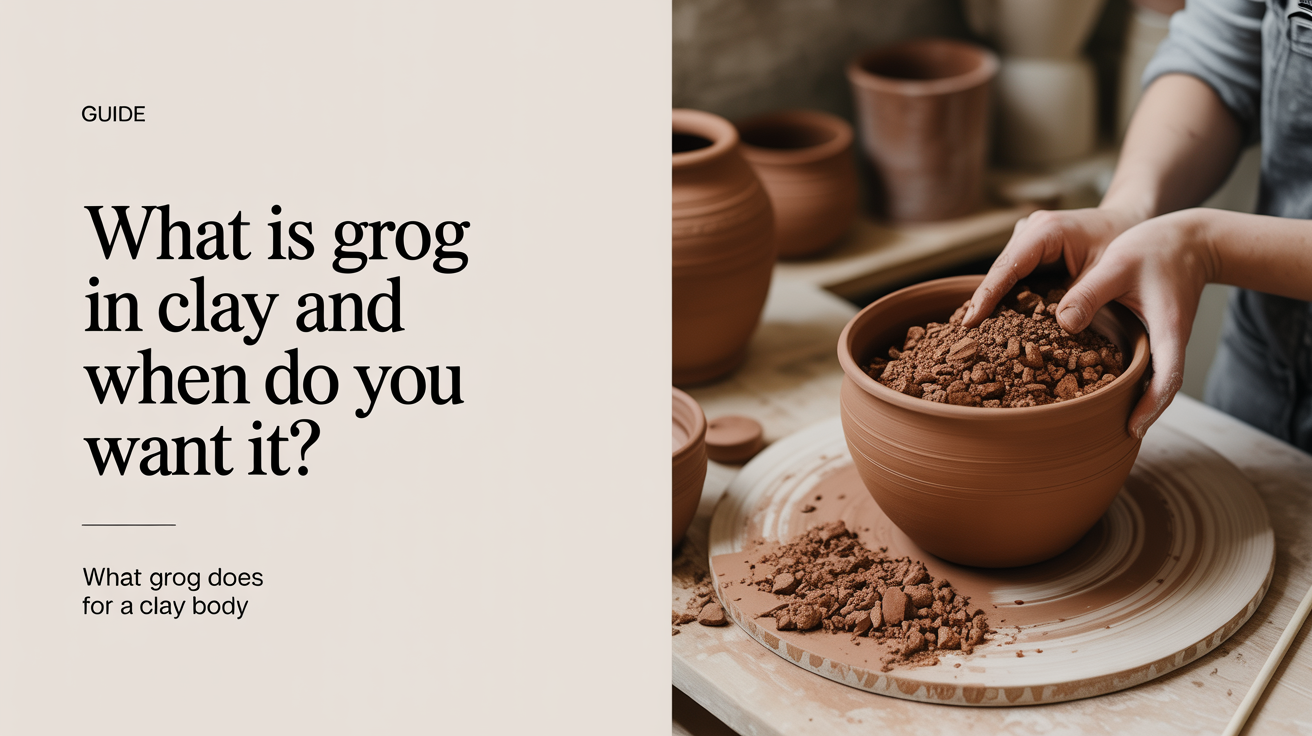
The practical effects of grog show up at every stage of the making process, not just at firing.
During drying, the inert particles interrupt the clay matrix and create micro-channels that let moisture escape more evenly. This slows down differential drying (the surface drying faster than the core) and reduces the tension that causes cracks to form. Thick-walled work and large flat slabs benefit the most from this.
During firing, that same interrupted matrix resists the shrinkage and thermal stress that can warp or crack a piece. Most clay bodies shrink 10 to 13 percent from wet to fired; a heavily grogged body may shrink only 8 to 10 percent. The difference is meaningful for large sculptures or tiles where dimensional accuracy matters, and for anything built thick.
During building, grog adds what potters call "tooth": a slight drag or grip that helps coils stay where you put them, slabs hold their shape when cut, and walls stay upright when stacked. Without it, very plastic smooth clays can slump under their own weight before they stiffen.
Key things grog does for a clay body:
- Reduces overall drying and firing shrinkage
- Slows moisture loss to prevent surface cracking
- Resists warping in large, flat, or thick pieces
- Adds texture and grip for hand-building
- Improves thermal shock resistance in some bodies (particularly relevant for wood or raku firing)
- Makes the clay body less dense and slightly lighter at comparable wall thickness
Fine vs. Coarse Grog: Which Mesh Size Matters
Not all grog is the same, and the particle size changes the experience considerably.
Fine grog (60 to 80 mesh) is almost invisible in the fired clay surface. It adds internal structure without dramatically changing the feel of the clay in your hands. Porcelain bodies occasionally use fine grog to add stability without losing the smooth, refined surface that makes porcelain attractive. Decorators who apply slips, underglazes, or detailed carving to the surface prefer a fine-grogged body because the coarse particles do not disrupt fine detail or scratch tools.
Medium grog (40 to 60 mesh) is the most common range for general-purpose stoneware. You can feel the particles but they do not aggressively abrade your palms. Many mid-fire cone 6 throwing bodies fall into this category, offering a balance of texture and workability.
Coarse grog (20 to 30 mesh) is visible as speckles in the fired surface and produces a notably rough texture. Sculpture clays, raku bodies, and wood-fire clays often use coarse grog because those applications involve thick walls, dramatic temperature changes, or surfaces where texture is part of the aesthetic. The downside is that coarse grog is genuinely hard on hands during extended throwing sessions.
When Hand-Builders Want Grog
Hand-builders generally benefit more from grog than wheel throwers, and the reason comes down to wall thickness and building time.
Pinch pots, coil builds, and slab work tend to produce thicker walls than thrown pots, especially for beginners. Thick walls trap moisture longer, and that uneven drying is the main cause of cracks. A grogged body dries more forgivingly. The tooth also helps coils bond to each other and keeps slabs from curling at the edges during drying.
Large-scale hand-built work, sculpture, and anything that sits on the shelf partially built for days before completion needs a body that can handle that kind of extended exposure. Sculpture clays with 20 to 30 percent coarse grog exist specifically for this situation. The type of clay you start with shapes every decision that follows, and for hand-builders that usually means starting with a body that has at least some grog.
Tiles and flat work are another strong case. A smooth, plastic clay body will almost certainly warp as a large tile dries because the edges dry faster than the center. A grogged body resists this dramatically. Potters who make functional tile often use bodies with 20 percent or more grog, sometimes supplemented by sand, for exactly this reason.
When Throwers and Porcelain Potters Want It Smooth
On the wheel, grog changes the equation. Throwing requires the clay to respond to fast, repeated pressure from wet hands. Smooth, plastic clay centers more easily, opens cleanly, and pulls up into thin walls with less effort. Coarse grog resists that movement and wears on the skin of the fingers and palms over a long session.
Most commercial throwing bodies use fine grog at low percentages, or no grog at all, to keep the clay responsive and comfortable. Porcelain is the clearest example: traditional porcelain bodies are formulated for maximum smoothness, translucency, and refined surface, so grog is generally kept minimal or absent. Choosing the right clay body as a beginner depends partly on your building method, and wheel throwers who want to stay comfortable and productive often do better with a smooth or lightly grogged stoneware.
That said, even throwers sometimes reach for a grogged body. Woodfire and raku potters who throw heavy, robust forms often prefer a clay with some grog to handle thermal shock during fast cooling. Salt and soda firing creates surface effects that work well with visible texture. The firing process and the aesthetic goal both influence what grog percentage makes sense.
Cone temperature affects how clay bodies mature and how grog performs at different firing ranges, so matching your clay body to your intended cone is part of the same decision.
Smooth vs. Grogged Clay: A Direct Comparison
| Feature | Smooth Clay | Grogged Clay |
|---|---|---|
| Feel in hands | Silky, plastic, responsive | Gritty to rough depending on mesh size |
| Throwing suitability | Excellent | Fair to poor (coarse) |
| Hand-building suitability | Moderate | Good to excellent |
| Shrinkage | Higher (10 to 13%) | Lower (8 to 11%) |
| Crack resistance (thick walls) | Lower | Higher |
| Surface for decoration | Clean, fine detail | Textured; may disrupt fine carving |
| Best uses | Wheel throwing, delicate forms, porcelain | Sculpture, tiles, hand-building, raku |
| Hardness on hands | Gentle | Rougher with coarse grog |
Effect on Surface and Finishing
Grog affects more than structure. The texture it creates shows up in the fired surface and interacts with glazes in specific ways.
Coarse grog creates peaks and valleys in the clay surface. Thin glazes tend to pull back from the peaks and pool in the valleys, producing a mottled or broken-glaze effect that many potters find attractive. Thick, opaque glazes cover the texture more completely. If you are aiming for a glassy, uniform glaze surface, a smooth body is more predictable.
For surfaces left unglazed (natural ash, terra sig over burnished clay, slip-decorated work), grog texture becomes part of the visual interest. Wood-fire potters often choose heavily grogged clays partly because the coarse surface catches ash deposits and creates more varied surface effects during firing.
If you plan to do detailed carving or sgraffito through slip, coarse grog particles can catch your tool unexpectedly and create unintended marks. Fine-grogged or smooth bodies give you cleaner control for detailed surface work.
Burnishing, the technique of polishing leather-hard clay with a smooth stone or spoon, requires a smooth clay body. Grog particles interrupt the surface too much to burnish effectively.
Frequently Asked Questions
Can I add grog to a smooth clay body myself?
You can, though it requires thorough wedging to distribute the particles evenly. Buy powdered or granular grog from a ceramic supplier and wedge it in small amounts at a time into a reclaim or commercial body. Start with 10 percent by dry weight and adjust. The difficulty is even distribution: uneven grog concentration can create weak spots. Pre-grogged commercial bodies are more consistent, so adding your own grog is most useful when you have specific needs that commercial options do not meet.
Does grog burn out in the kiln?
No. Grog is already ceramic, meaning it has already been fired once. It does not burn, melt at standard pottery temperatures, or change significantly during your firing. That is the whole point: it stays inert and holds the surrounding clay in place.
Is grogged clay harder to recycle and reclaim?
Not meaningfully harder. Grogged clay reclaims the same way smooth clay does: dry it out completely, slake it in water, and wedge or pug it when it reaches working consistency. The grog particles remain in the reclaim. The main practical note is that heavily grogged reclaim can feel coarser than when you first bought it because the grog percentage becomes more concentrated as finer particles wash away during drying. This is rarely a significant issue.
What grog percentage should a beginner use?
For general hand-building, a body with 10 to 20 percent grog is a reasonable starting point. It gives you the stability benefits without making the clay feel uncomfortably rough. If you are primarily throwing on the wheel, look for a body with fine grog at 10 percent or less, or a smooth body with no listed grog. Your supplier's product descriptions and clay body spec sheets will tell you the grog content and mesh size.
Does grog affect how strong the finished piece is?
The relationship between grog and fired strength is not straightforward. Grog reduces cracking during drying and firing, so it can improve the odds of a piece surviving to completion. In the fired state, a well-grogged body often has good thermal shock resistance, which matters for wood or raku firing. For functional tableware fired in a standard electric or gas kiln, the grog content has less effect on the strength of the finished glaze piece than the cone temperature and the clay body's maturity at that temperature.